Product · Matvision Refine
A few contaminants downgrade
the whole load. Take them out.
Multi-sensor detection and one to four robots to extract the pieces that keep an otherwise clean stream from meeting specification.

> 98 %
Final quality rate on the cleaned stream
Up to 40 t/h
E40 in negative sorting
10 – 200 mm
Particle size, overlapping pieces accepted
1 – 4
Robots, sized to the contaminant
Throughput and purity depend on the stream and on the configuration. They are assessed during the performance study. A line is configured for the value it recovers, not for the number of sensors it carries.
What you gain
- The steel sold at the clean grade
- The copper sold as an output of its own
- Every category priced separately
What you avoid
- A lot downgraded at the buyer’s gate
- A picking result that changes with the shift
Applications
Built for your stream.
Two streams first, where the loss is largest; a third when purification is all it needs.
E40 steel scrap
Copper armatures, attached pieces, cables and rubber out of the ferrous load, up to 40 t/h.
WEEE and batteries
Batteries and battery-bearing devices out before the shredder, while the pieces are still whole.
How it works
Read everything,
pick a few.
- 01
Material on the belt
The stream arrives already largely clean. What follows is about the few pieces that should not be there.
- 02
Read in one pass
The Matvision Sense block measures every piece as it goes by: relief, colour, and what X-ray transmission sees inside it. One pass, no second look.
- 03
The model gives each piece a class
At the exit of the sensing block, every piece carries a decision. Most are exactly what the buyer expects and stay as they are. A few are contaminants: those take a colour, and a destination.
- 04
Only the marked pieces are picked
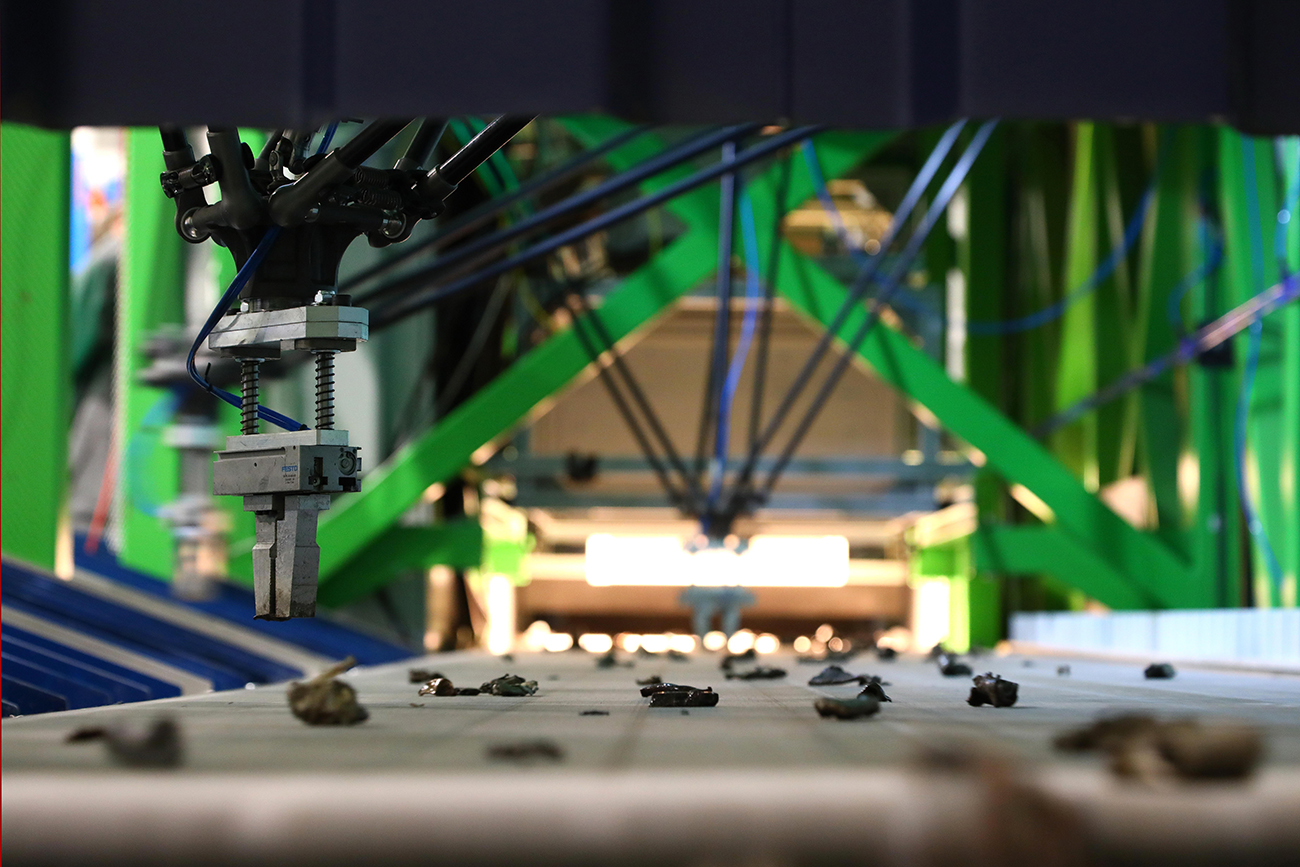
A delta robot drops its gripper and takes the piece that does not belong. Purification is not sorting: we remove the few rather than classify the many.
- 05
Each class to its own bin
The contaminants leave by their chute, one output per class. The cleaned stream carries on to the end of the belt, unchanged.
- 06
One report per output
Each output leaves with its own composition: what it holds, in pieces and in weight, and the software version, model and thresholds behind the figures. The line does not stop to produce it.
The problem it solves
The magnet is not wrong.
It is thorough.
An overband magnet pulls out steel, and it pulls out everything attached to steel. An electric motor is a steel casing with a copper winding inside: it leaves with the ferrous scrap. An aluminium profile held by one steel screw does the same. Cables, rubber and non-magnetic pieces follow. None of these are steel, all of them end up in the E40 load, and a small share of them is enough to downgrade the whole lot at the buyer’s gate.
Purification is not sorting. We do not classify every piece into a family; we find the few pieces that should not be there and remove them, at a throughput a full sorting line cannot reach, because extracting a few contaminants from a clean stream is much faster than classifying every piece of a mixture.
Application cases
The few pieces that cost you the lot.
E40 steel scrap: copper armatures, ferrous-attached pieces, cables, rubber
E40 steel scrap is already largely clean. What remains is what the magnet took along. X-ray transmission sees the copper winding inside a motor casing; the 3D profilometer and the colour camera pick up cables, rubber and non-ferrous pieces. Robots extract them, and the cleaned stream meets the specification the buyer pays for.
Throughput up to 40 tonnes per hour, depending on stream and particle size, confirmed by a performance study
Old zinc contaminated with lead
Zinc from roofing and end-of-life parts carries lead, including solder on sheets. Two pieces of zinc can look identical and carry very different lead content. X-ray transmission and LIBS separate the contaminated pieces from the clean zinc, with a clearer view of contamination than a visual inspection gives.
Sensors: XRT, LIBS
Batteries in WEEE
Appliances that still contain a battery must be set aside before shredding: lithium-ion cells are a fire risk in storage and in the shredder. Matvision Refine detects battery-containing equipment and extracts it, so the rest of the stream can be processed safely.
Contaminants in Zorba before fine sorting
Printed circuit boards, lead pieces and other unwanted items are detected and removed ahead of family sorting, so the downstream line works on a cleaner stream.
Precious metals before the shredder
Connectors, pins and populated boards carry a large share of what a WEEE lot is worth and a small share of what it weighs. Taken off the belt before the rest goes to the shredder, they leave in their own container rather than diluted through everything else.
Purifying an IBA non-ferrous fraction
Incinerator bottom ash gives up a non-ferrous fraction that still carries what a refiner will not pay for. Removing those pieces raises the grade of a fraction that has already cost you the screening.
Configuration
One to four robots,
sized to the contaminant.
| Sensing core | Matvision Sense: 3D, colour, XRT. LIBS when the contaminant is an alloy question. |
|---|---|
| Robots | One to four. |
| Ejection | Robotic picking, pneumatic ejection, or both on the same line. |
| Conveyor | Included. |
| Particle size | 10 to 200 mm. Overlapping pieces are accepted: no singulation stage is required. |
| Quality | Final quality rate above 98 percent on the cleaned stream, measured on the material concerned. |
| Throughput | Up to 40 t/h on E40 in negative sorting, depending on stream and particle size, confirmed by a performance study. |
| Outputs | The cleaned stream, plus one output per contaminant class. |
| Streams | E40, e-waste, battery extraction, precious metal recovery, IBA purification. |
| Return on investment | One to three years, depending on the composition of the stream. |
| Naming | Matvision Refine, then robots and sensors: Refine 2 CDX, Refine 4 CDXL. |
Configured, not chosen
One line, many ways to run it.
Two plants with the same contaminant rarely want the same machine. What varies is not the sensors alone: it is the strategy, the number of arms, how the work is shared between them, and what actually takes a piece off the belt.
Modes and recipes
A line holds several recipes and moves between them. A stream that changes with the delivery does not need a new machine each time; it needs the right recipe selected, and the operator to be able to select it.
Sorting strategies
Positive or negative: pick what you want, or take out what you do not and let the rest run. A class can be given to one robot, or spread across several when its share of the stream justifies the redundancy.
A hazardous class can be routed straight out on its own, on a different rule from the rest: lithium cells before a shredder, for instance.
One to four robots
The number follows the density of what has to be picked, not a catalogue tier. A line can start with fewer arms and grow with the stream.
Robots, air, or both
Picking is not the only way off a belt. A pneumatic ejector handles what is small, fast or too abundant to be worth an arm, and the two work on the same line: robots on the pieces that need placing, air on the ones that only need removing.
Grippers, and who takes what
The gripper is chosen for the material. The work is then shared between the arms: some take everything that passes, others only the large pieces, others the small ones. How that sharing is set is often what decides the rate a line actually holds.
Retrofit, or a new line
The sensing block and the robots can be installed over a conveyor you already run, when its width, speed and surroundings allow it: that is the configuration shown at the top of this page. Where the existing line cannot take it, the machine comes with its own conveyor, and the two are commissioned together.
The sensing core
Matvision Sense sits at the head of the line, in the configuration the stream justifies: from a single sensor to the full stack. It is the same core, and the same models, as a Matvision Sense unit on its own.
What we measure, what we promise
Residual contamination,
against what you lose with it.
The KPI of a purification system is the residual contamination of the cleaned stream, against the share of good material lost with the contaminants. Both are measured during the performance study and written into the offer. Return on investment is typically one to three years depending on the composition of the stream, confirmed on your material.
Need every fraction, not just a cleaner stream? Matvision Grade ↗