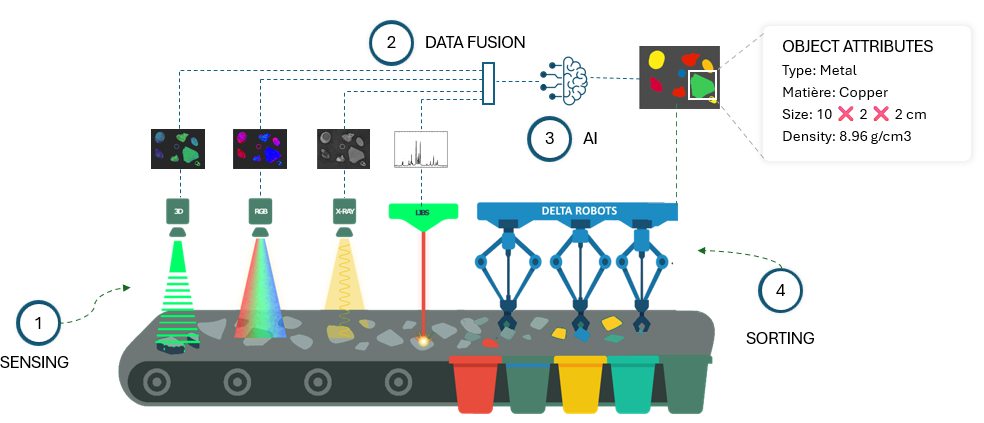
For many years, optical sorting and sensor-based sorting (SBS) were treated as synonymous. The dominant paradigm was straightforward: select the appropriate sensor for a given waste stream, calibrate it properly, and interpret its signal through predefined thresholds, rule-based logic, or, to a limited extent, conventional machine learning methods.
This approach proved effective as long as material differences were sufficiently distinct and decision boundaries remained simple. However, as waste streams have become more heterogeneous and material compositions more complex, the limits of purely sensor-driven, threshold-based systems have become increasingly apparent.
Without innovation, a company is on life support!
Sylvain Montmory
The era of classical sensor-based sorting
Traditional sensor-based sorting systems relied on deterministic interpretation of sensor outputs. Once the correct sensing modality was selected, X-ray transmission for density contrast, visible imaging for color separation, inductive sensing for metals, the classification logic was often based on thresholding or simple regression algorithms.
For example, in an X-ray transmission (XRT) system for metals, if the estimated effective atomic number or density proxy exceeds a predefined threshold, the object is classified as part of the heavy fraction. In a SWIR-based plastic sorting system, if reflectance within a specific wavelength band exceeds a calibrated threshold, the object is classified as the target material.
These systems were not simplistic from an engineering standpoint. On the contrary, they required careful calibration, environmental stabilization, white/dark balancing, and ongoing maintenance to ensure measurement consistency over time. Operating X-ray, hyperspectral, or spectroscopic systems in harsh recycling environments is technically demanding and often capital-intensive.
However, the classification logic itself remained largely binary and rule-based, partly because mechanical separation architectures were themselves binary (eject or pass). As a result, most systems operated under relatively simple decision frameworks.
This paradigm worked effectively when material differences were large and clearly separable under one sensing modality.
But as waste streams became more heterogeneous, these deterministic approaches reached structural limits.
The distruption introduced by artificial intelligence
Artificial intelligence has significantly reshaped industrial systems, and recycling is no exception. Traditional computer vision approaches required engineers to explicitly define the rules distinguishing one object from another, encoding shape descriptors, contour heuristics, texture filters, or spectral thresholds. Such rule-based systems are complex to maintain and often fail to generalize under real-world variability.
In contrast, supervised machine learning, particularly deep learning, enables models to learn discriminative features directly from labeled datasets. Instead of manually specifying decision rules, neural networks extract high-dimensional representations that can approximate, and in some cases exceed, human perceptual discrimination.
While AI applied to RGB imaging can match human sorting capabilities, its true impact emerges when extended to complex sensor data. The combination of advanced sensing modalities and data-driven models fundamentally changes how sorting decisions are derived.
The broader implications of AI in recycling, including dataset design, model drift, and long-term operational stability, warrant dedicated analysis and will be addressed separately. Here, we focus specifically on how AI transforms the interpretation of sensor data within sorting architectures.
Smart sorting: AI applied to advanced sensors
Smart sorting represents the convergence of advanced sensing and artificial intelligence. Rather than applying simple thresholds to X-ray, hyperspectral, or spectroscopic signals, AI models can now process high-dimensional sensor outputs and identify patterns that are not accessible through classical calibration logic. This unlocks capabilities that go beyond human perception.
For example, detection of trace elemental signatures indicating specific alloy compositions, identification of hazardous components such as embedded batteries in electronic waste reducing fire risks, recognition of subtle compositional differences within visually similar materials, and differentiation of alloy families that share density or color characteristics but differ in elemental profile.
AI models trained on multi-sensor data can exploit relationships between spectral features, geometric structure, and density proxies in ways that are not linearly separable using threshold-based logic. This marks a shift from sensor-based sorting, meaning sensor plus rule-based interpretation, to smart sorting, meaning sensor plus data-driven, adaptive interpretation.
Beyond human vision
When AI is applied only to RGB cameras, it tends to replicate human perceptual ability. But when AI is applied to non-visible sensing modalities such as XRT, LIBS, hyperspectral imaging, it begins operating in domains inaccessible to human senses.
An operator cannot visually detect the presence of zinc within an aluminum alloy. A human cannot see internal battery components in WEEE. A person cannot directly perceive spectral absorption peaks in the short-wave infrared range.
AI applied to these sensor domains extends sorting beyond imitation of human cognition into augmentation of industrial intelligence. This is where smart sorting becomes structurally different from traditional SBS.
Engineering considerations and stability
The integration of AI into advanced sensing systems introduces new engineering challenges, including dataset representativity and labeling quality, long-term model stability under changing acquisition conditions, drift management due to sensor aging or environmental variation, and robust validation and confidence threshold tuning.
Training AI on complex sensor data requires controlled acquisition, calibration discipline, and structured validation workflows to ensure stable deployment over time. When properly implemented, however, AI-driven smart sorting systems enable classification tasks that are infeasible under traditional deterministic frameworks.
The direction of the industry
The historical separation between “vision systems using AI” and “sensor-based sorting systems using thresholds” is dissolving. Increasingly, AI models are applied directly to data streams from X-ray, hyperspectral, and spectroscopic sensors.
We believe this convergence defines the future of industrial sorting.
Smart sorting is not merely an incremental improvement in classification accuracy. It represents a structural evolution in how sensing, data interpretation, and mechanical action interact within recycling systems.
This perspective is explored in greater depth in our chapter on smart sorting in Sustainable Processes in the Circular Economy (Elsevier), where sensing, data processing, and mechanical separation are analyzed as an integrated system rather than isolated components.
Hello, I’m Bonnie ! I hold a Bachelor’s degree in Communication and Journalism and am currently pursuing a Master’s in Science, Technology and Society. My work focuses on how technology, innovation, and media intersect with society, especially in areas like sustainability, science communication, and digital transformation. Each post reflects my exploration of these themes, aiming to make complex ideas more accessible and impactful.